 hr@ninjacodingpro.com
 ninjacodingpro
 +92 315 6421641
If you have been freelancing for a few years, you have probably felt it: fewer replies, more competition, and clients who suddenly ask, “Can’t AI do this?” Jobs that used to land in a day now take weeks, and some never land at all. If that sounds familiar, you are not alone, and it is not a sign that you are a bad freelancer.
Freelancing has not died. It has changed. The freelancers who adapt are still getting strong clients and better rates. In this guide we break down what has actually changed, why clients are harder to find, and a practical plan to handle it.
What Actually Changed?
Three shifts happened at the same time, and together they made the market feel much harder.
- The cost of simple work dropped. Tasks like basic copywriting, simple designs, small scripts and template websites can now be produced quickly with AI tools. Many clients try these tools first before hiring anyone.
- Competition increased. Anyone can now produce a decent-looking portfolio or proposal in minutes, so marketplaces and inboxes are more crowded than ever.
- Clients became more careful. Budgets are tighter and buyers expect faster delivery, clearer results and proof that you are worth the money.
The work that is still valuable is the work that needs judgement: understanding a business, choosing the right approach, connecting systems together and being accountable for the result.
Why You Are Not Getting Clients
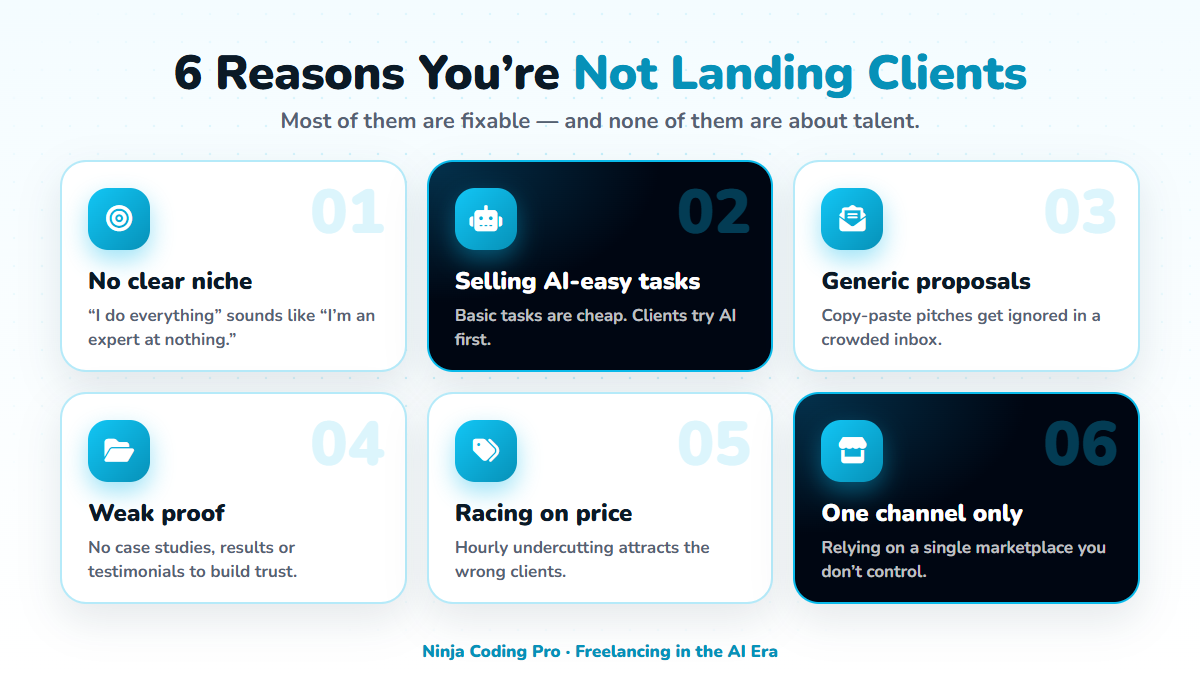
Before changing your strategy, be honest about which of these reasons applies to you. Most freelancers who struggle have two or three of them at once.
1. You have no clear niche
“I do web design, SEO, writing, apps and social media” sounds flexible, but clients read it as “not an expert in anything”. Buyers want a specialist for their specific problem.
2. You are selling what AI now does for free
If your whole offer is something a client can do with a free tool in ten minutes, it is hard to justify a fee. The value now lies in strategy, quality, integration and results, not in raw output.
3. Your proposals are generic
A copy-pasted “Dear Sir, I can do this job” message gets lost among dozens of identical ones. Clients respond to proposals that show you read their brief and understood their problem.
4. You have weak proof
No case studies, no measurable results and no testimonials means the client has to take a risk on you. Proof removes that risk.
5. You are competing on price
Undercutting other freelancers attracts clients who value price above everything, and they are usually the hardest to work with. It is a race you cannot win against AI or against lower-cost markets.
6. You depend on one channel
If all your work comes from a single marketplace, one algorithm change or one account problem can take your income down. You need more than one way for clients to find you.
How to Handle the Situation: The AI-Era Playbook
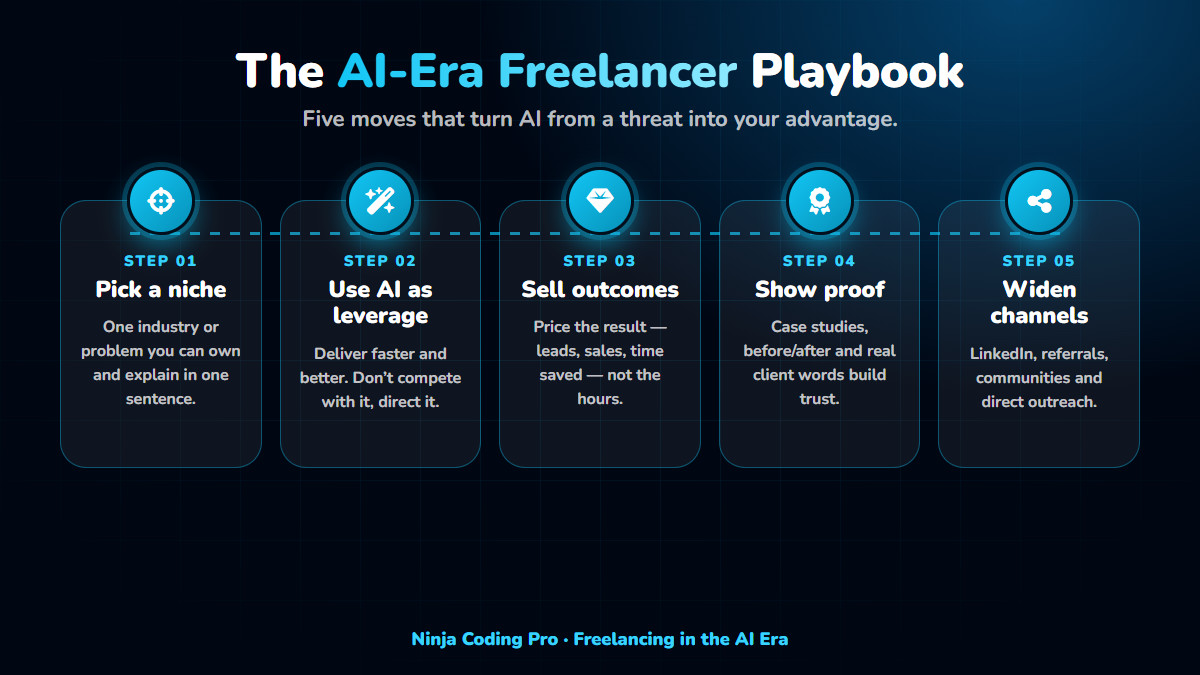
Step 1: Choose a niche you can own
Pick an industry, a platform or a problem, and become known for it. For example, instead of “web developer”, try “WordPress developer for clinics” or “automation specialist for real estate agencies”. A narrow focus makes your marketing easier, your proposals stronger and your rates higher.
Step 2: Use AI as leverage, not as a rival
The freelancers who win are not the ones who avoid AI; they are the ones who use it to deliver faster and at a higher standard. Use it for research, first drafts, testing, documentation and repetitive work, and spend your saved time on strategy and quality. Tell clients honestly how you use it: faster delivery with expert review is a selling point.
Step 3: Sell outcomes, not hours
Clients do not want “10 hours of development”. They want more leads, more sales, less manual work or a site that loads fast. Describe your service in terms of the result, and price it based on the value it creates. Fixed-scope packages and monthly retainers also give you steadier income than one-off hourly jobs.
Step 4: Build proof that is easy to trust
Turn every finished project into a short case study: the problem, what you did and what changed. Add before-and-after screenshots, a short client quote and, where you can, real numbers. Even two or three strong case studies beat a long list of unexplained projects.
Step 5: Do not rely on one marketplace
Marketplaces are useful, but treat them as one channel of several. Build a simple presence around:
- LinkedIn: share what you learn, your case studies and your opinions on your niche. Connect with the people who hire.
- Referrals: ask happy clients directly. One good referral is worth many cold proposals.
- Agencies and partnerships: many agencies need reliable specialists to handle overflow work.
- Direct outreach: write short, personal messages to businesses you can genuinely help, and mention one specific improvement you would make.
- Your own website: a clear page that explains who you help, how, and how to contact you.
Move Up the Value Ladder
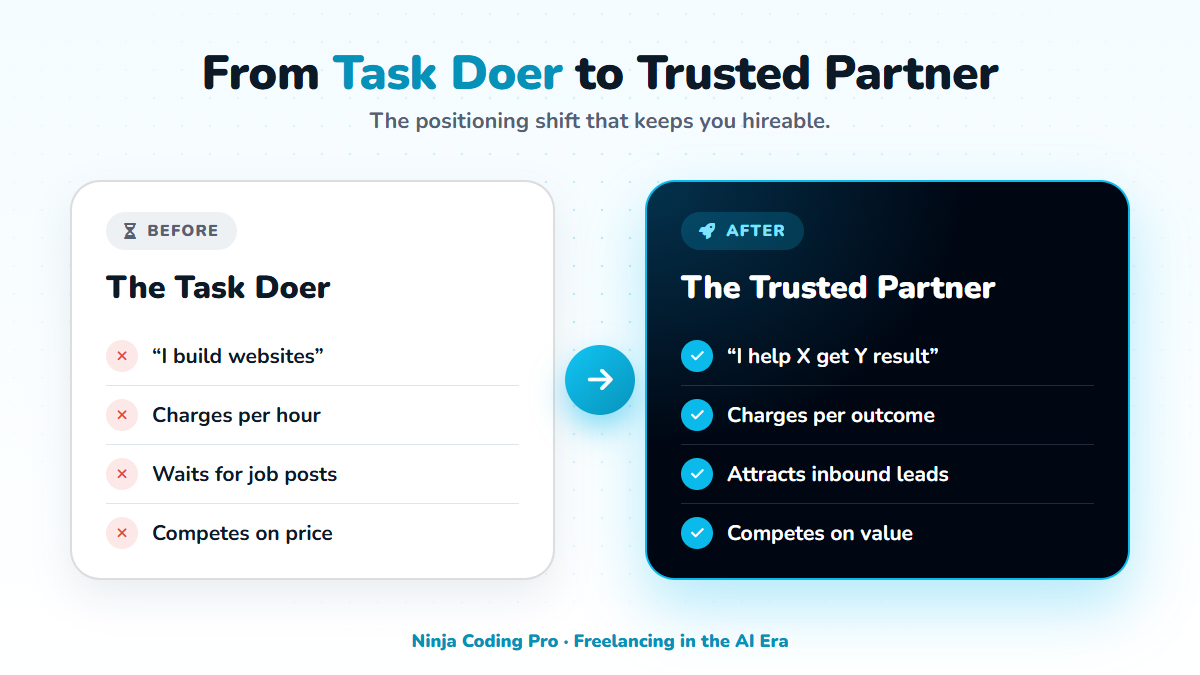
The biggest mindset change is from “task doer” to “trusted partner”. A task doer waits for a brief and delivers it. A partner understands the business, recommends what to build, builds it and keeps improving it after launch. Partners are much harder to replace with a tool.
Services where AI creates new demand rather than replacing work are a good place to grow:
- AI integration into existing websites, apps and workflows
- Custom chatbots for support and lead qualification
- Business automation and CRM systems, such as GoHighLevel setups
- Connecting tools through APIs and webhooks
- Performance, security and ongoing maintenance
These services need real understanding of a client’s business and systems, which is exactly where a human expert still has the advantage.
A Simple Proposal Structure That Gets Replies
- Show you understood: restate their problem in one or two sentences.
- Give a quick idea: one specific suggestion that shows your thinking.
- Show relevant proof: one short case study link, not your entire portfolio.
- Explain the outcome and timeline: what they will get and when.
- End with a low-pressure next step: for example, a short call or a quick question.
Keep it short. A proposal that can be read in thirty seconds is far more likely to be answered.
Your 30-Day Action Plan
- Week 1: Decide your niche and write a one-sentence offer: “I help [who] get [result] by [how].”
- Week 2: Turn your best two or three projects into case studies and update your profiles and portfolio.
- Week 3: Start posting on LinkedIn, message past clients for referrals and send 10 personalised outreach messages.
- Week 4: Learn one AI-related skill you can add to your service, and create a fixed-price package or a monthly retainer offer.
Consistency matters more than perfection. Small steps every week will move you further than one big burst of effort.
Final Thoughts
AI has made simple work cheaper and the market louder, but it has also created a new kind of demand for people who can apply technology to real business problems. Freelancers who specialise, use AI smartly, prove their results and communicate like partners are still in demand.
The market did not stop needing skilled people. It stopped needing generic ones. Become specific, become visible and become reliable, and the clients will follow.
At Ninja Coding Pro, we help businesses with AI integration, custom chatbots, GoHighLevel automation, WordPress and Shopify development. If you are a business looking for a reliable technology partner, get in touch with our team.

Altaf Latif
Altaf Latif writes about AI integration, automation and growth at Ninja Coding Pro.
 Apr 16, 2026
 Apr 14, 2026
 Apr 12, 2026
Comments (0)